


Ahrefs vs. SEMrush: The One Feature That Decides the Winner in 2026
For any professional in the digital marketing space, the choice between Ahrefs and SEMrush represents a critical strategic decision. These are not merely tools, they are comprehensive platforms that shape workflows, inform strategy, and drive results. The decision is not about which platform is definitively better, but rather which serves as the right strategic partner for a specific set of goals and operational realities.
The fundamental difference lies in their core philosophies. Ahrefs operates as an SEO-first platform, a specialist’s scalpel engineered for depth and precision, particularly in backlink analysis and organic research workflows. In contrast, SEMrush is a comprehensive digital marketing suite, a Swiss Army knife designed to integrate SEO with PPC, content strategy, social media, and local marketing into a single, unified command centre.
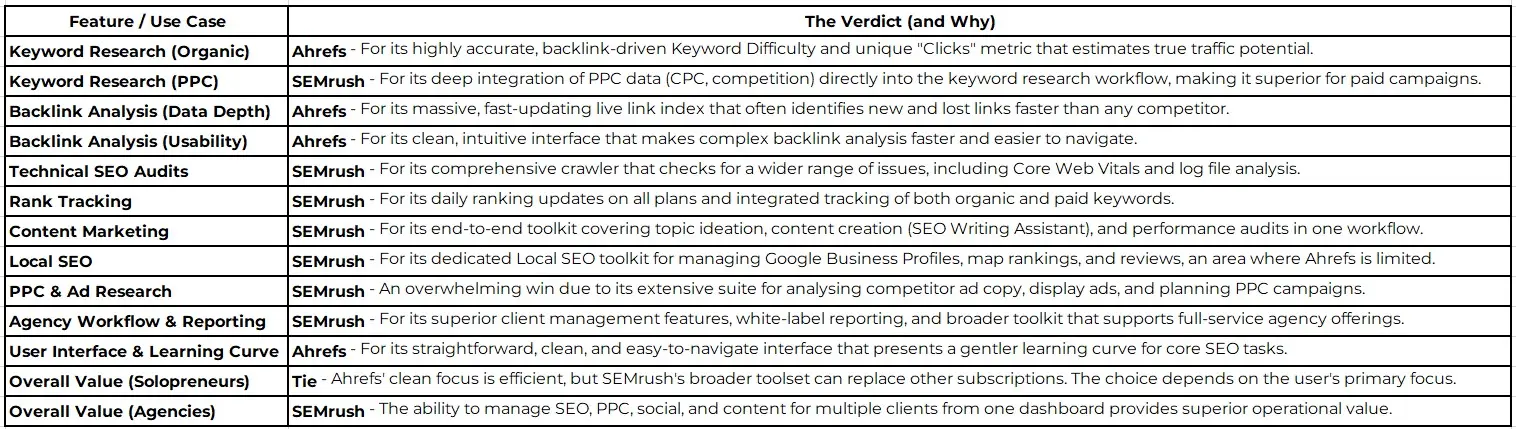
Looking toward 2026, the next frontier in this competition is the AI Arms Race. Both platforms are rapidly evolving beyond traditional SEO tools into AI-powered marketing platforms. For those needing immediate clarity, the following table summarizes the verdict for each key area of comparison.
The Feature Deep Dive: A Head-to-Head Analysis
A detailed examination of each platform’s core functionalities reveals how their distinct philosophies translate into tangible strengths and weaknesses. Remember, these are premium tools; if you are looking for solutions that fit a smaller operation or budget, we have a complete guide to the best SEO tools for every budget and need.
Keyword Research: The Art of Uncovering Opportunity
The foundation of any successful SEO campaign is robust keyword research. Both platforms offer powerful tools, but they prioritize different metrics and workflows.
- Database and Scope: Ahrefs claims a database of 28.7 billion keywords across 217 locations, while SEMrush reports 27.3 billion keywords in 142 locations. For businesses focused on the United States, SEMrush claims a larger specific database, which could provide an edge in that market.
- Ahrefs Edge is its focus on organic ranking potential. Its Keyword Difficulty score is widely praised for its accuracy because it is heavily weighted by the number of referring domains a top-ranking page has. This gives a clear, link-building-focused target. Furthermore, Ahrefs provides two unique and invaluable metrics, Clicks and Traffic Potential.
- SEMrush Edge is its breadth of data and superior organization for content strategy. The Keyword Magic Tool is exceptional for grouping and filtering keywords, particularly by search intent, which is crucial for planning content clusters. SEMrush also provides more detailed tracking of a wider variety of SERP features, including AI overviews and knowledge panels.
- AI Integration: Both platforms are incorporating AI to streamline research. Ahrefs uses AI to generate keyword suggestions and help decode search intent percentages for a given term. SEMrush employs its Copilot feature to analyse data and provide personalized, AI-powered recommendations and curated keyword clusters.
- Verdict: Ahrefs is the choice for the SEO purist who requires the most accurate assessment of organic difficulty and realistic traffic potential. SEMrush is built for the content strategist and PPC manager who need advanced organization, intent analysis, and fully integrated paid search data.
Backlink Analysis: The Currency of Authority
For years, backlink analysis has been Ahrefs signature strength, but SEMrush has made significant strides to close the gap.
- Database Size and Freshness: While raw numbers vary between sources, with SEMrush claiming a 43 trillion backlink index and Ahrefs a 35 trillion index, the more critical factor is data freshness. Ahref is consistently lauded for having the largest live link index, powered by the second-most active web crawler after Google
- User Interface and Workflow: Ahrefs maintains a clear advantage in usability. Its interface for backlink analysis is cleaner, more intuitive, and requires fewer clicks to access essential data reports. SEMrush’s interface, while powerful, can feel more complex and less streamlined for this specific task.
- Ahrefs offers the standout Link Intersect tool, which efficiently identifies domains linking to multiple competitors but not to your site, a goldmine for targeted outreach. It also provides excellent contextual data, showing the text surrounding an anchor, which helps in assessing the quality of a link.
- SEMrush provides a more complete, action-oriented workflow. It includes a built-in Link Building Tool with CRM-style features for managing outreach campaigns, a feature Ahrefs lacks. Furthermore, its toxic backlink detection and direct integration with Google’s Disavow tool create a seamless process for conducting link audits and clean-ups.
- Verdict: Ahrefs remains the industry leader for pure backlink discovery, data freshness, and analytical usability. SEMrush is a powerful competitor that wins if the primary need is an integrated workflow that combines discovery, outreach, and audit within a single platform.
Technical & On-Page SEO: Auditing for Peak Performance
A technically sound website is the bedrock of SEO success. Both platforms offer robust site audit tools, but they approach the task differently.
- Audit Depth and Scope: SEMrush is generally considered the more comprehensive tool in this category. Its site audit is more thorough, checking for a wider array of technical issues, including Core Web Vitals, HTTPS implementation.
- Actionability and Prioritization: Ahrefs strength lies in its simplicity and focus. Its audit checks for over 170 key issues and presents them in a clear, prioritized list based on severity, culminating in an easy-to-understand Health Score.
- AI and Automation (2026 Factor): Ahrefs is pioneering a feature called Patches, which uses AI to automate simple technical SEO fixes, such as writing and deploying meta tags directly to a website, thereby reducing dependency on developer resources. SEMrush offers a highly effective On-Page SEO Checker that provides concrete, page-specific recommendations for improvement, making it very actionable for content teams.
- Verdict: SEMrush provides the most comprehensive and in-depth technical audit, ideal for deep diagnostics. Ahrefs offers a faster, more user-friendly, and priority-driven audit, with ground breaking potential for automated implementation.
Rank Tracking: Monitoring Your Digital Footprint
Tracking keyword performance is essential for measuring success and adapting strategy. Here, the differences in update frequency and scope are stark.
- Update Frequency: SEMrush holds a significant advantage by offering daily ranking updates on all its paid plans. This is critical for monitoring volatile SERPs or tracking the impact of algorithm updates. Ahrefs, by contrast, provides weekly updates by default. Daily updates are only available through the expensive Project Boost Max add-on, which costs an additional $200 per month, per project.
- Scope of Tracking: Both tools track keyword positions across different devices and geographic locations. However, SEMrush excels in tracking a broader array of SERP features and uniquely allows users to monitor both organic and paid keyword rankings within the same interface.
- AI Search Tracking (2026 Factor):Both platforms are adding capabilities to track visibility within AI-powered search engines. SEMrush can track positions in ChatGPT and Google AI Mode. Ahrefs has launched a dedicated tool called Brand Radar, which monitors brand visibility, citations, and sentiment across a wider range of major chatbots, including ChatGPT, Gemini, Perplexity, and Microsoft Copilot.
- Verdict: For conventional rank tracking, SEMrush is the clear winner due to its standard daily updates and integrated paid/organic monitoring. Ahrefs, however, shows a strong future-facing advantage with its dedicated and comprehensive tool for tracking brand presence in AI search.
The Multi-Channel Marketing Arena: Content, PPC, Social & Local
This is the area where the core philosophies of the two platforms diverge most sharply, and where SEMrush establishes its identity as an all-in-one marketing suite.
- Content Marketing: Ahrefs offers a powerful Content Explorer for identifying high-performing content and spotting content gaps, along with an AI Content Helper add-on. However, SEMrush provides a complete, end-to-end Content Marketing Toolkit. This integrated suite assists with every stage of the content lifecycle, topic research, content brief creation, real-time writing optimization with the SEO Writing Assistant, and performance auditing.
- PPC & Advertising: Ahrefs capabilities here are minimal, largely confined to displaying CPC data for keywords. SEMrush offers a dedicated Advertising Toolkit for researching competitor ad copy, analysing display and video ad strategies, planning entire PPC campaigns, and even launching AI-powered Google and Meta ads directly from the platform.
- Social Media: While Ahrefs has recently added a Social Media Manager for scheduling posts, SEMrush offers a full Social Toolkit. This includes scheduling, performance analytics, competitor monitoring, and even influencer discovery tools.
- Local SEO: Ahrefs local SEO features are restricted to local keyword research. SEMrush provides a dedicated Local SEO Toolkit that enables users to manage and optimize Google Business Profiles, track local map rankings, and manage online reviews with AI assistance.
- Verdict: This is an overwhelming victory for SEMrush. Its superiority across content marketing workflows, PPC, social media, and local SEO is the single greatest differentiator between the two platforms.
User Experience & Workflow: Interface, Usability, and Support
A tool power is only useful if it can be wielded effectively. The user experience of Ahrefs and SEMrush is a direct reflection of their design philosophies.
- Learning Curve and UI: Ahrefs is consistently praised for being more user-friendly, with a cleaner, more intuitive interface that is easier to navigate. For users focused purely on SEO tasks, the learning curve is gentler. SEMrush, with its vast array of over 55 tools, can feel overwhelming to new users and presents a steeper learning curve. Its dashboard is dense with data, which is a strength for power users but can be a barrier for beginners.
- Workflow Integration: SEMrush designed for cross-tool integration, allowing a user to move seamlessly from keyword research to creating a content brief to scheduling a social media post promoting the finished article. Ahrefs workflow is more linear, focused on excellence within the core SEO pillars of auditing, research, link building, and tracking.
- Support and Education: Both platforms offer world-class educational resources, including blogs, video tutorials, and certification courses. When it comes to direct support, SEMrush has an edge by offering more accessible channels, including phone support and product demos.
- Verdict: Ahrefs wins on ease of use and a gentler learning curve for its core SEO feature set. SEMrush wins for its breadth of workflow integrations and more accessible customer support options.
Pricing & Value Proposition: Deconstructing the Investment for 2026
The final decision often comes down to cost and value. Both platforms represent a significant investment, and their pricing models have crucial differences that impact the total cost of ownership.
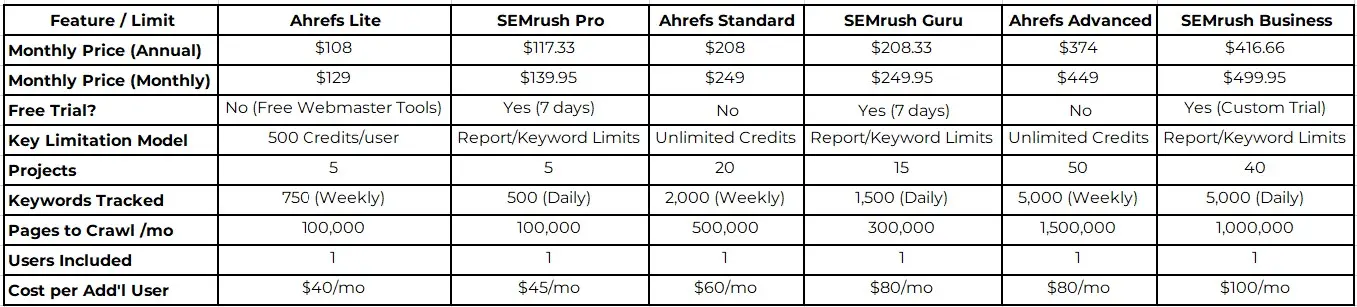
- Core Plans: The sticker prices for the main tiers are comparable. SEMrush plans are Pro ($139.95/month), Guru ($249.95/month), and Business ($499.95/month). Ahrefs plans are Lite ($129/month), Standard ($249/month), and Advanced ($449/month), reflecting recent price increases. Both offer a discount of around 17% for annual billing.
- Ahrefs uses a credit-based system on its lower-tier plans. The Lite plan, for example, comes with 500 credits per user per month, with most reports or filter applications consuming one credit.
- SEMrush uses a more traditional model of hard limits on reports, projects, and keywords, combined with a modular add-on system. Users purchase the core SEO toolkit and can then add on other toolkits (Local, Social, etc.) as needed.
- Free Options: SEMrush offers a significant advantage with its 7-day free trial, allowing users to fully test the platform before committing. Ahrefs does not offer a traditional free trial but provides free Webmaster Tools with limited functionality for verified site owners and a very low-cost ($29/month) .
The Final Verdict: Which SEO Suite Is Right for You in 2026 and Beyond?
The analysis culminates in a clear set of recommendations based on user persona and strategic objectives.
Choose Ahrefs if…
- You are an SEO specialist, consultant, or part of an SEO-focused team where organic search performance is your primary mandate.
- Your most critical and frequent workflows involve deep backlink analysis, strategic link building, and granular organic competitor research.
- You prioritize a clean, intuitive user interface and a faster learning curve for executing core SEO tasks with maximum efficiency.
- You are forward-looking and believe the future of SEO involves automated technical fixes to reduce developer reliance and deep analysis of brand presence in AI chatbots.
Choose SEMrush if…
- You are a full-stack digital marketer, a marketing agency, or an in-house team responsible for multiple channels including SEO, PPC, Content, and Social Media.
- You require an integrated platform where insights from one channel (e.g., keyword gaps in SEO) can seamlessly inform strategy in another (e.g., a new PPC campaign).
- Your core responsibilities extend to local SEO, comprehensive content marketing workflows, or social media management.
- You need robust agency-specific features like white-label reporting, client management tools, and the assurance of daily rank tracking updates for performance-focused clients.
Frequently Asked Questions (FAQs)
Is Ahrefs better than SEMrush for agencies?
This depends entirely on the agency service model. For SEO-specialist agencies that focus heavily on link building and technical SEO, Ahrefs can be an excellent choice. Its superior backlink analysis UI and the ability to work with unlimited verified domains are significant advantages. However, for full-service digital marketing agencies that manage SEO alongside PPC, content, and social media, SEMrush is the definitive winner.
Which is more accurate, Ahrefs or SEMrush?
Neither tool is 100% accurate, both provide sophisticated estimates-based data and proprietary algorithms. The consensus in the industry is that Ahrefs is generally more accurate for backlink data, due to its faster crawler, and for estimating organic traffic potential. SEMrush is often considered strong in its keyword volume estimates and overall market traffic analysis, with its broader data inputs providing a holistic view.
What is a cheaper alternative to SEMrush and Ahrefs?
For businesses and freelancers on a tighter budget, several high-value alternatives provide excellent functionality at a lower price point.
- SE Ranking: A strong all-around alternative that covers most SEO essentials, including keyword research, site audits, and backlink analysis, with plans starting around $52 per month.
- Moz Pro: A well-respected tool that is particularly strong for basic SEO analysis, keyword research, and link data. Its entry-level plans start between $39 and $79 per month.
- Ubersuggest: A very budget-friendly option, excellent for beginners or those with basic needs. It focuses on keyword research and content ideas, with plans starting as low as $12 per month.