

The Best SEO Tools (2026): A Complete Guide for Every Budget & Need
Trying to do SEO without the right tools is like navigating the ocean without a compass. You might be paddling hard, but without data to guide you, you’re likely headed in the wrong direction. In a digital landscape that’s constantly shifting, especially with the rise of AI-driven search, having the right toolkit is no longer a luxury, it’s a necessity for survival and growth.
The sheer number of SEO software options can be overwhelming. You are faced with questions about which tools to choose, how to manage your budget, and the fear of making the wrong investment. This guide is definitive map you need. It will break down everything you need to know about the best SEO tools on the market, from enterprise-grade all-in-one suites to powerful and specialized free tools.
This comprehensive resource is tailored for every budget, from $0 to premium, and every skill level, from a new blogger to a seasoned agency professional. With a focus on 2026 and beyond, these recommendations are made with a clear eye toward the future of search, ensuring you are equipped not just for today’s challenges, but for the evolving world of AI Overviews and new optimization workflows.
What Are SEO Tools and Why Are They Non-Negotiable?
At its core, an SEO tool is any software designed to help improve a website visibility in search engines like Google and Bing. Increasingly, this definition is expanding to include AI-powered answer engines like ChatGPT and Perplexity. These tools provide the critical data and insights necessary to make strategic decisions, turning SEO from a guessing game into a data-driven science.
While it was once possible to manage SEO with spreadsheets and manual checks, the complexity of modern search algorithms and the scale of the web have made that approach obsolete. Today, using SEO tools is non-negotiable for four key reasons.
Saving Time and Resources
The most immediate benefit of SEO tools is the immense amount of time they save. Manual SEO is not just inefficient; it’s a drain on your most valuable resource. Consider the time investment for manual tasks, a thorough SEO setup for a small local business can take between 22 and 36 hours. On-page SEO work alone can consume nearly a third of a marketing agency’s time.
Automation tools handle these repetitive tasks in minutes, not days. Research shows that 75% of marketers leverage AI-powered tools specifically to reduce the time spent on manual work like keyword research and meta-tag optimization. This shift allows you to focus on high-level strategy, creative content development, and audience engagement instead of getting bogged down in data entry.
Providing Accurate, Actionable Data
Effective SEO is built on a foundation of accurate data. Without tools, you are operating in the dark. SEO platforms provide reliable metrics on keyword search volume, keyword difficulty, competitor backlink profiles, site health, and ranking performance data points that are impossible to gather manually at scale. This data empowers you to make smarter decisions, prioritize your efforts, and ultimately achieve a higher return on your investment.
Gaining a Competitive Edge
SEO is a competitive arena. Your rivals are using sophisticated tools to analyse the market and find an edge. SEO software allows you to turn the tables by analysing what’s working for your competitors. You can identify the exact keywords they rank for, the websites that link to them, and their most successful content. This intelligence enables you to spot gaps in their strategy, learn from their successes, and build a proactive plan to outperform them.
Measuring ROI and Proving Value
For anyone accountable for marketing results, be it a freelancer, an agency, or an in-house marketer, proving the value of SEO is paramount. SEO tools provide the robust tracking and reporting systems necessary to connect your optimization efforts to tangible business outcomes. By tracking metrics like organic traffic growth, keyword ranking improvements, and conversion rates from organic search, you can clearly demonstrate the ROI and secure buy-in for future initiatives.
How to Choose the Right SEO Tool for You
Before you look at a single product page or pricing plan, the first step is to look inward. The best SEO tool is entirely subjective, it’s the one that best fits your unique context, goals, and resources. The process of choosing a tool is a strategic exercise in itself, forcing you to clarify your marketing objectives. The tool you ultimately select will be a direct reflection of the strategy you intend to execute.
To find your perfect fit, consider these key decision factors.
Your Specific Goals
What, precisely, are you trying to accomplish? Vague goals lead to poor tool choices. Get specific about your primary objectives. Are you focused on:
- Content Strategy: Discovering keywords and content topics to drive traffic?
- Technical Health: Auditing your website for technical errors like broken links, slow page speed, or crawlability issues?
- Competitive Analysis: Understanding what your competitors are ranking for and how they’re earning backlinks?
- Link Building: Finding websites for backlink opportunities and managing outreach campaigns?
- Local SEO: Improving your visibility in local search results and Google Maps?
Your top goals will dictate which features are must-haves versus nice-to-haves.
Your Budget
SEO software spans a wide financial spectrum, from completely free tools to enterprise suites costing thousands of dollars per month. Be realistic about your budget, but frame it as an investment, not an expense. The right tool acts as a force multiplier for your efforts, and studies show the typical ROI for SEO can be as high as 748%.
For context, a solid all-in-one SEO platform for a small business often falls in the $100 to $300 per month range. Many providers also offer significant discounts for annual billing, which can provide better value if you’re committed for the long term.
Your Business Size & User
Who will be using the software? The answer dramatically changes the requirements.
- Solopreneur or New Blogger: The priority is often affordability, ease of use, and strong features for keyword research and content optimization.
- Small Business Owner: A user-friendly tool with good reporting capabilities and strong local SEO features is often the best fit.
- SEO Agency or Freelancer: Needs are more complex, requiring robust platforms that can manage multiple client projects, offer white-label reporting, and provide deep competitive analysis and scalable outreach features.
Ease of Use & Learning Curve
A powerful tool with a confusing interface is a wasted investment. As you evaluate options, ask yourself if the platform feels intuitive. Check for the quality of customer support, tutorials, and documentation, as these resources are invaluable when you’re learning a new system.
Never commit to a long-term plan without a hands-on test drive. Almost every major SEO software offers a free trial. Use this period wisely to perform real-world tasks:
- Set up a project for your own website.
- Run a full site audit to find technical errors.
- Add your top 10 most important keywords to the rank tracker.
- Research three new keyword ideas for your next blog post.
- Analyse a top competitor domain to see their best pages and backlinks.
Data Accuracy and Freshness
Your SEO strategy is only as good as the data it’s built on. Investigate where a tool gets its data and how frequently it’s updated. Some metrics, like Domain Authority or Visibility Score, are proprietary to each tool. Take the time to understand what these metrics mean and how they are calculated. The goal is to find a tool with data you can trust to make critical business decisions.
The Main Categories of SEO Tools
The SEO software landscape can be broken down into several key categories. While many tools overlap, understanding these distinctions will help you build a well-rounded toolkit.
All-in-One SEO Platforms
Think of these platforms as the Swiss Army Knives of SEO. They serve as a central command centre, combining the functionality of multiple specialized tools into a single, integrated suite. They typically cover everything from keyword research and rank tracking to technical audits and backlink analysis, making them ideal for users who want a comprehensive, unified solution.
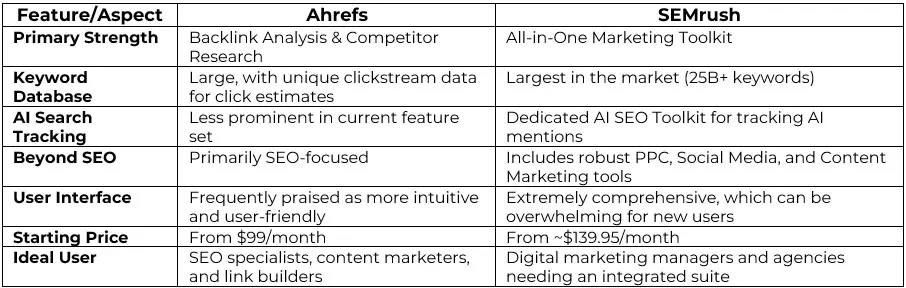
SEMrush
- Best For: All-in-one SEO and digital marketing management, especially for businesses that also run PPC, content, and social media campaigns.
- Key Features: SEMrush boasts one of the largest keyword databases on the market (over 25 billion), a powerful site audit tool, daily position tracking, and extensive backlink analytics. A standout feature is its AI SEO Toolkit, which helps you monitor your brand’s visibility and mentions in AI-generated search results. Its broad suite of tools extends beyond SEO to cover the full marketing spectrum.
- Pricing: Plans start from approximately $139.95 per month.
Ahref
- Best For: Deep competitor analysis, backlink research, and content strategy planning.
- Key Features: Ahref is renowned for its industry-leading backlink index, which is often considered the largest and most accurate available. Its Content Gap tool is excellent for finding keyword opportunities your competitors rank for but you don’t. The Keywords Explorer tool is enhanced with clickstream data, providing more realistic estimates of how many clicks a keyword will generate.
- Pricing: Plans start from $99 per month.
For a deeper comparison, read our full guide: Ahrefs vs. SEMrush: An Unbiased Showdown.
Specialized Keyword Research Tools
Keyword research is the bedrock of any successful content strategy. These specialized tools go deep to help you understand what your audience is searching for, the intent behind their queries, and the competitive landscape for those terms.
AnswerThePublic
- Best For: Understanding search intent, generating content ideas, and discovering long-tail, question-based keywords.
- Key Features: This tool takes a seed keyword and visualizes related searches into search clouds organized by questions (who, what, why), prepositions, and comparisons. It’s a goldmine for brainstorming blog post titles, FAQ sections, and content that directly answers the conversational queries people use in search.
- Pricing: Offers a freemium model with a few free searches per day, paid plans start from around $11 per month.
Ubersuggest
- Best For: Small businesses, bloggers, and beginners who need affordable and easy-to-digest keyword insights.
- Key Features: Developed by Neil Patel, Ubersuggest provides keyword ideas along with key metrics like search volume, SEO difficulty, and CPC data. It also offers helpful content ideas by showing you the top-performing pages for any given keyword.
- Pricing: Has a limited free tier, with paid plans known for being very budget-friendly.
To explore more options, see our Complete Guide to the Best Keyword Research Tools.
Technical SEO & Auditing Tools
Technical SEO is the foundation upon which your entire website rests. It involves ensuring that search engines can efficiently crawl, interpret, and index your site’s content. Technical auditing tools act as a health check for your website, diagnosing critical issues like broken links, slow page speed, duplicate content, improper redirects, and crawl errors that can severely hinder your rankings.
Screaming Frog SEO Spider
- Best For: Conducting in-depth, comprehensive technical SEO audits. It is the de facto industry standard for SEO professionals.
- Key Features: Screaming Frog is a powerful desktop-based crawler that simulates how a search engine spider views your site. It meticulously scans every URL to find broken links, audit redirects, analyse page titles and meta descriptions, discover duplicate content, and generate XML sitemaps. Its power lies in its extensive configuration and filtering options, allowing for highly detailed analysis.
- Pricing: The free version allows you to crawl up to 500 URLs, which is sufficient for many small websites. The paid license costs approximately $259 per year for unlimited crawling and access to advanced features.
SE Ranking
- Best For: Small businesses and teams on a budget who need an affordable and effective cloud-based site audit tool.
- Key Features: While an all-in-one platform, SE Ranking Website Audit feature is particularly strong. It checks your site against over 130 parameters and presents a clear, prioritized list of issues to fix, making it very user-friendly.
- Pricing: Plans start from approximately $65 per month.
Learn how to diagnose your site with our list of 5 Must-Have Technical SEO Tools.
Link Building & Outreach Platforms
Backlinks from other websites to yours are one of the most powerful ranking signals. They act as votes of confidence that tell search engines your site is authoritative and trustworthy. Link building outreach platforms are designed to streamline the incredibly time-consuming process of finding potential linking sites, locating contact information, sending personalized emails, and tracking follow-ups and responses.
BuzzStream
- Best For: Managing end-to-end outreach campaigns at scale. It is ideal for dedicated link builders, agencies, and in-house teams.
- Key Features: BuzzStream functions as a complete outreach Customer Relationship Management system. It helps you discover prospects, automatically finds their contact information, allows you to send personalized email sequences, and tracks your entire communication history. This prevents embarrassing duplicate emails and ensures no opportunity is missed. Its Buzzmarker Chrome extension is a standout feature for efficient prospecting.
- Pricing: Plans start from $24 per month.
Hunter.io
- Best For: A specialized tool focused on one thing, quickly finding and verifying email addresses for any domain.
- Key Features: Hunter.io is simple but powerful. Its Domain Search feature finds all publicly available email addresses associated with a website, and its Email Verifier checks the deliverability of an address to reduce your bounce rate. It is an essential companion to a broader outreach platform like BuzzStream.
- Pricing: Offers a free plan for 25 searches per month. Paid plans start from around $34 per month.
Scale your efforts with our guide to the 7 Best Link Building Tools.
Rank Tracking Software
You can’t improve what you do not measure. Rank tracking software is essential for monitoring your website positions in the search engine results pages for your most important keywords. This allows you to accurately measure the success of your SEO campaigns, identify ranking drops as soon as they happen, and benchmark your performance against your competitors over time.
SE Ranking
- Best For: The best overall value for accurate, feature rich rank tracking, with particularly strong capabilities for local SEO.
- Key Features: SE Ranking tracks keyword positions at both national and local levels across all major search engines. It provides a proprietary Visibility Score to gauge overall performance, tracks which SERP features (like featured snippets or map packs) you own, and offers detailed competitor tracking.
- Pricing: Plans start from approximately $65 per month.
Nightwatch
- Best For: Agencies and businesses that require highly accurate and granular local rank tracking.
- Key Features: Nightwatch is known for its precision in local SEO, with the ability to monitor rankings in over 107,000 locations, right down to the ZIP code level. It features a clean, visual interface with graphs and charts that make it easy to analyse performance trends at a glance.
- Pricing: Offers scalable plans suitable for agencies managing multiple clients.
On-Page SEO Tools
On-page SEO tools help you optimize the content and structure of your individual web pages. This involves ensuring your content thoroughly covers a topic, targets the right keywords, is well structured with proper headings, and ultimately satisfies search intent. These tools provide real time, data-driven feedback to help you craft content that is primed to rank.
SurferSEO
- Best For: Data-driven on-page optimization and creating highly competitive content.
- Key Features: SurferSEO analyses the top-ranking pages for your target keyword and generates a data-backed content brief. This includes recommendations for ideal word count, important terms and phrases to include, and optimal content structure. Its Content Editor provides a real-time optimization score as you write, guiding you toward creating a comprehensive and relevant article.
- Pricing: Plans start from $99 per month.
Yoast SEO
- Best For: WordPress users, especially beginners, who need a simple, guided approach to on-page and basic technical SEO.
- Key Features: As one of the most popular WordPress plugins, Yoast provides real-time feedback directly within the WordPress editor. It gives simple red, orange, or green light signals for keyword usage, readability, title tag length, and meta descriptions. It also handles essential technical tasks in the background, like generating XML sitemaps and setting canonical URLs to prevent duplicate content issues.
- Pricing: Offers a robust free version that covers all the essentials. A premium version is available with additional features.
The Best FREE SEO Tools That Pack a Punch
You don’t need a six-figure budget to make a significant impact with SEO. A wealth of high-quality, genuinely useful free tools can form the backbone of any successful strategy. For new bloggers, small businesses, or anyone just starting, these tools provide invaluable data without any financial commitment.
The Google Trinity: Your Non-Negotiable Foundation
These three tools from Google are essential. If you use nothing else, use these.
- Google Search Console: This is your direct line of communication with Google. It provides first-party data on how Google sees your site. Its benefits include seeing which keywords you rank for, monitoring clicks and impressions, submitting sitemaps for faster indexing, identifying crawl errors, and checking your site health via Core Web Vitals and mobile usability reports. It is the ultimate source of truth for your site performance in Google Search.
- Google Analytics 4 (GA4): While GSC tells you, what happens before a user clicks, GA4 tells you what happens after they land on your site. Its benefits include tracking where your traffic comes from, understanding user behaviour and engagement, and measuring conversions and goal completions. It’s crucial for understanding the business impact of your SEO efforts.
- Google Keyword Planner: Although it’s a part of the Google Ads platform, this tool is invaluable for organic keyword research. Its primary benefit is providing official search volume data directly from Google, allowing you to gauge the popularity and competition level for keywords you are considering.
Other Top-Tier Freebies
Beyond Google ecosystem, several other companies offer incredibly generous free tools.
- Ahrefs Webmaster Tools: This free offering from Ahrefs gives verified website owners access to their powerful Site Explorer and Site Audit tools. You can run a comprehensive technical audit of your site and analyse your backlink profile features that are normally part of a premium subscription.
- Screaming Frog (Free Version): As mentioned earlier, the free version of this desktop crawler allows you to scan up to 500 URLs. For most small to medium-sized websites, this is more than enough to conduct a thorough technical audit to find broken links, redirect issues, and more.
- Bing Webmaster Tools: Do not forget that Google is not the only search engine. Bing Webmaster Tools is the equivalent of GSC for Microsoft search engine and offers a surprisingly robust set of features, including keyword research tools, site scans, and backlink analysis.
- AnswerThePublic: The free version provides a limited number of daily searches, which is often enough to generate a wealth of content ideas and question-based keywords for your next blog post.
Want more? Check out our full list of 15 Best FREE SEO Tools That Actually Deliver Results.
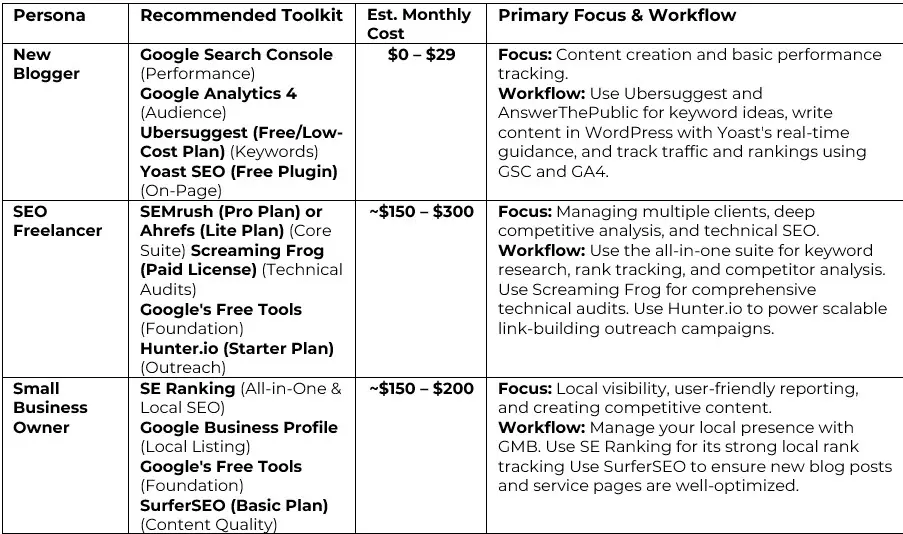
Our Recommended SEO Starter Kits
To make this guide as actionable as possible, we have curated three recommended toolkits based on common user personas. These stacks combine different tools to create a cost-effective and powerful solution tailored to specific needs and workflows.
Conclusion: Choosing Your Toolkit
The perfect, one-size-fits-all SEO tool does not exist. The best tool is the one that aligns perfectly with your specific goals, your budget, and your unique workflow. The purpose of this guide was to provide you with a comprehensive map of the landscape and a strategic framework for navigation. Now, you must choose your own path.
Feel confident in your ability to make an informed choice. Start small, take full advantage of free trials, and do not be afraid to adapt your toolkit as your skills and business needs evolve. The right set of tools will not only make your SEO efforts more efficient but also more effective, turning data into insights and insights into tangible growth.
What’s one SEO tool you can’t live without? Share your favourite in the comments below!